
Table of Contents
The Essential Facts (Read This First)
- ✅ PCOS officially renamed PMOS on May 12, 2026, by the Endocrine Society and global medical consensus
- ✅ It’s not just semantics – the name now reflects scientific reality: a metabolic-endocrine disorder, not just an ovarian problem
- ✅ 170 million women affected – with 70% currently undiagnosed, partly due to the misleading old name
- ✅ 85% have insulin resistance – metabolic screening is now emphasized in diagnosis
- ✅ 3-year transition period (2026-2028) – both PCOS and PMOS are acceptable during implementation
- ✅ Practical impact: Better diagnosis in younger women, metabolic screening becomes standard, type 2 diabetes prevention emphasized
- ✅ Why now? 14 years of global research, 22,000+ patient surveys, consensus from 50+ organizations across 195 countries
The Name That Got It Wrong (Until May 12, 2026)
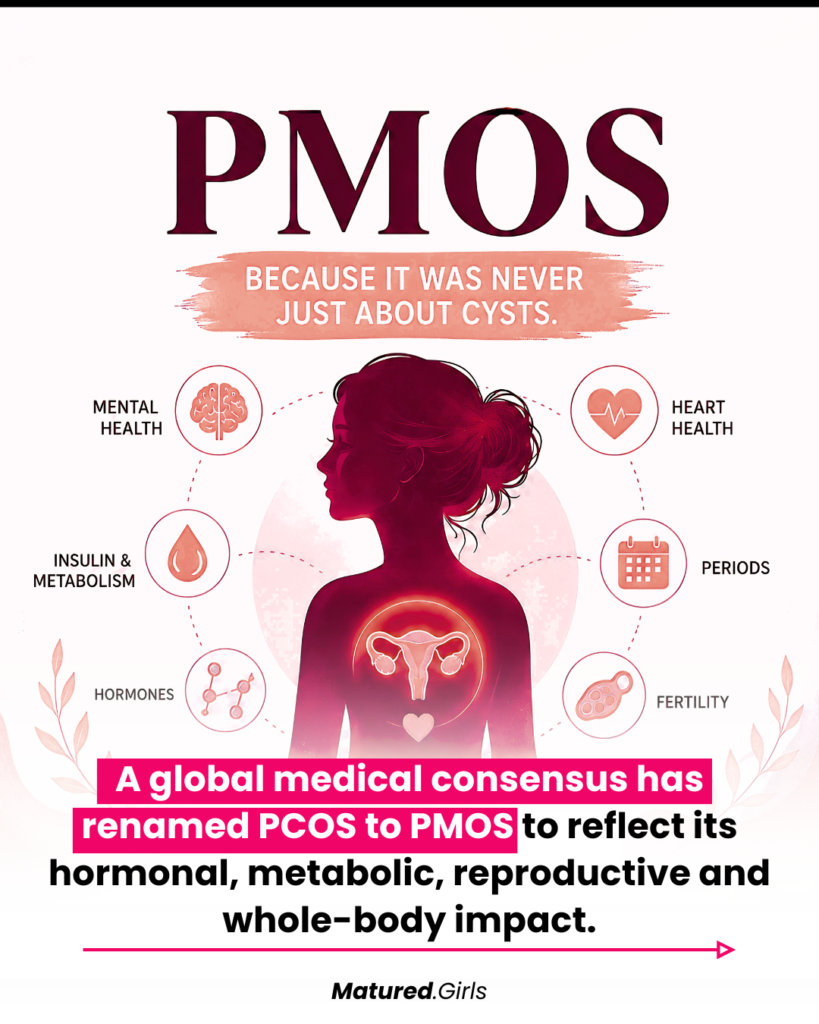
For nearly a century, one misleading name prevented millions of women from getting proper medical care.
On May 12, 2026, at the European Congress of Endocrinology in Prague, the medical world finally corrected this historic error.
Polycystic Ovary Syndrome (PCOS) officially became Polyendocrine Metabolic Ovarian Syndrome (PMOS).
If you’re thinking “It’s just a name change, right?”—you’re partially correct. But also profoundly wrong.
This name change represents a seismic shift in how medicine understands and treats one of the most common hormonal conditions affecting women. It’s the difference between looking at symptoms and treating the disease.
Why This Matters
The old name created a false medical narrative that lasted 90 years. It made doctors focus on ovarian cysts (which often aren’t even there). It made women think the problem was “just about fertility.” It left 70% of women undiagnosed. It delayed treatment for metabolic complications that could lead to type 2 diabetes, heart disease, and early death.
The new name fixes this. It says: This is fundamentally a metabolic problem. This is fundamentally an endocrine problem. This requires whole-body medicine.
Dr. Helena Teede, director of Monash University’s Centre for Health Research & Implementation and lead researcher of this 14-year global effort, explained the human cost:
“It was heart-breaking to see the delayed diagnosis, limited awareness, and inadequate care afforded those affected by this neglected condition. The new name finally accurately reflects the complexity of the condition.”
[Source: Endocrine Society, May 2026]
For comprehensive PCOS management, read our PCOS: Complete Guide for Women
- In Diet section → “For detailed meal plans: PCOD Diet: What to Eat“
- In Exercise section → “For daily control: How to Control PCOD Naturally“
- In Symptoms section → “For young women starting: PCOS Symptoms in Unmarried Girls“
What Does PMOS Actually Mean? Breaking Down the Name
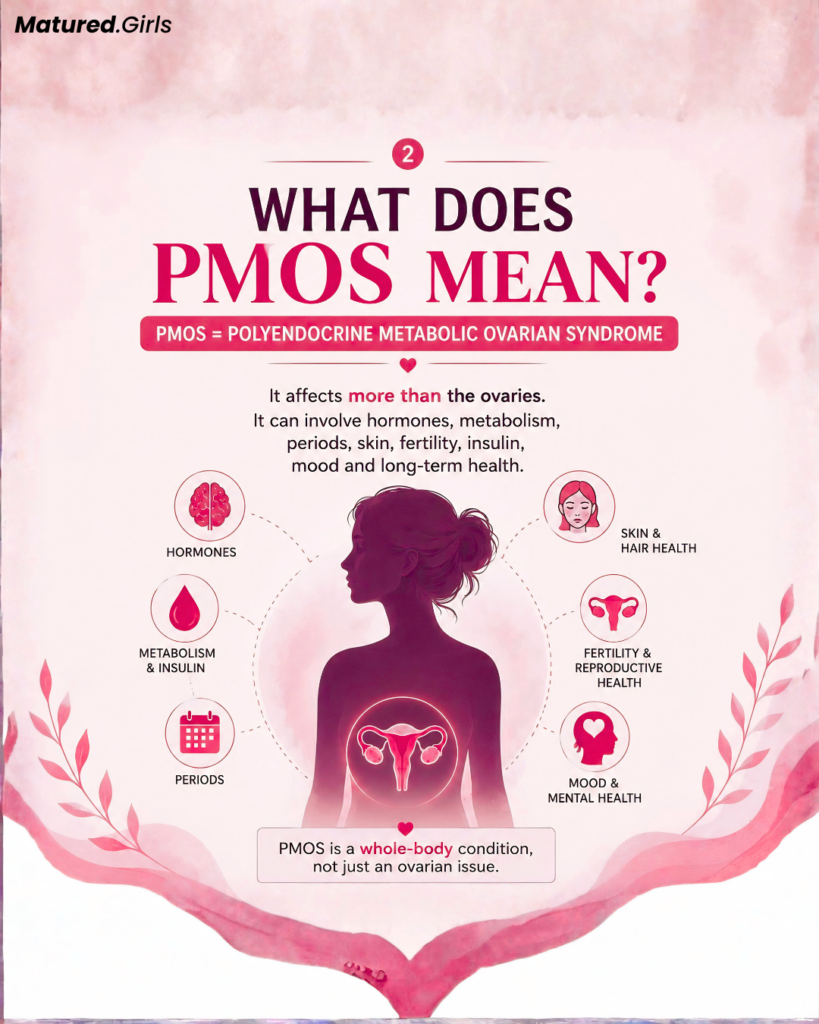
PMOS = Polyendocrine Metabolic Ovarian Syndrome
Each word carries crucial meaning:
| Term | What It Means | Why It Matters |
|---|---|---|
| Poly | Many | Multiple hormone systems affected (not just ovaries) |
| Endocrine | Hormone-producing glands/systems | It’s a hormonal disorder affecting your whole body |
| Metabolic | How your body processes energy & glucose | Insulin resistance is central (85% of patients have it) |
| Ovarian | Involving the ovaries | But cysts aren’t the main problem—they’re a symptom |
| Syndrome | Collection of interconnected symptoms | No single “smoking gun”—multiple systems malfunction together |
In plain English: Your hormones, metabolism, and reproductive system all malfunction together through one underlying mechanism—not three separate problems.
Why the Old Name (PCOS) Was Scientifically Wrong
The story starts in 1935.
Two Chicago surgeons named Irving Stein and Michael Leventhal were performing surgery on women with infertility. They noticed their patients had enlarged ovaries containing numerous small, cyst-like structures. When they surgically removed these “cysts,” some women’s cycles resumed and some became pregnant.
They declared victory. They’d found the problem: polycystic ovaries. They’d found the cure: surgery.
They were wrong.
Medical truth discovered 90 years later:
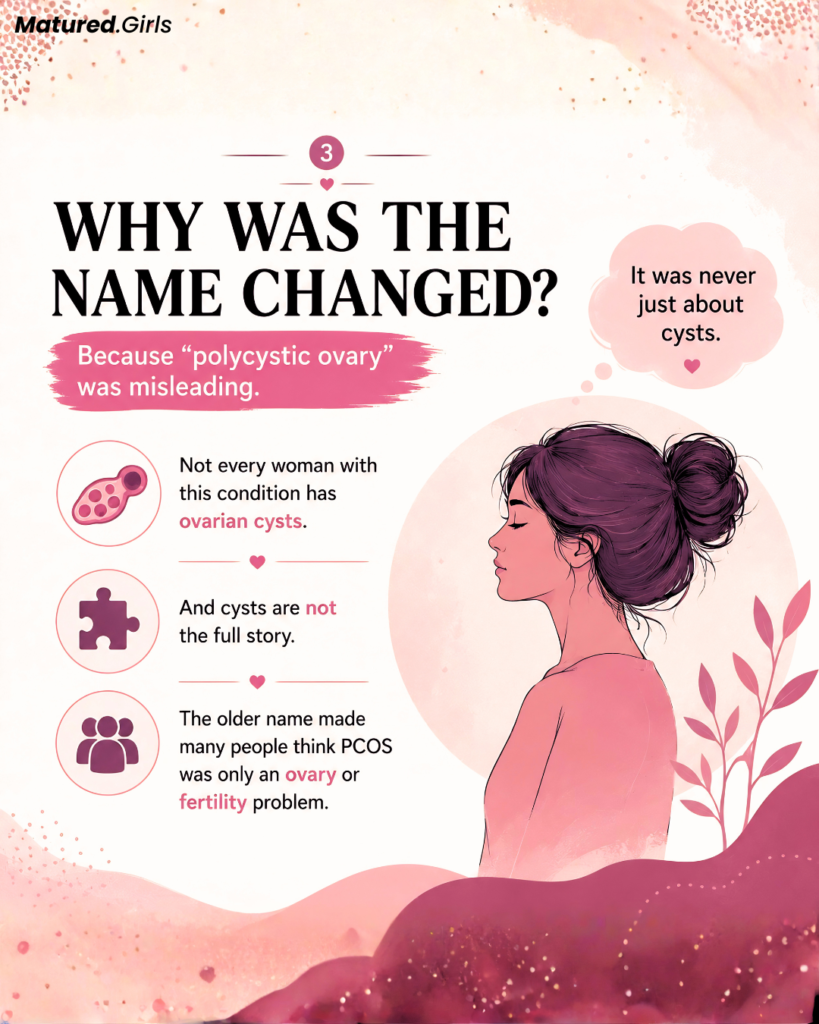
- Those “cysts” aren’t actually cysts—they’re normal underdeveloped egg follicles
- Surgery doesn’t cure the condition
- 30-40% of women with PMOS don’t have ovarian cysts at all
- The real problem isn’t in the ovaries—it’s in the hormones and metabolism
Yet the name “PCOS” persisted, creating a false narrative that sabotaged diagnosis and treatment for generations.
Prof. Terhi Piltonen, an obstetrician and gynecologist from Finland who helped lead the global naming consensus, described the damage bluntly:
“Many women, and even professionals, believe the PCOS ovary contains large cysts that can burst or require surgical treatment, whereas the truth is that the ovary is ‘full and lush’ with a high reserve of small underdeveloped follicles. The ovarian focus has done harm in the sense that many women have been ignored with their symptoms related to weight and other metabolic problems, mental distress, and skin manifestations.”
[Source: Endocrine Society Press Release, May 2026]
This wasn’t just an inconvenience. It cost women their health.
Why PCOS Was Renamed: The 14-Year Journey
This didn’t happen overnight. It took a decade and a half of global collaboration.
The Numbers Behind the Consensus
- 14 years of research and collaboration
- 50+ patient and professional organizations from 6 continents
- 22,000+ women surveyed about their experiences
- Multiple international workshops for expert discussion
- 195 countries involved in the consensus process
- Research leaders from endocrinology, reproductive health, psychiatry, dermatology, and cardiology
Led by Professor Helena Teede at Monash University in Australia, this wasn’t a top-down decision. It was democratic.
How They Actually Made the Decision
- Patient Voice First: 22,000 women with PCOS shared their experiences—delayed diagnoses, inadequate care, stigma, frustration
- Expert Collaboration: Clinicians from every relevant specialty discussed the condition’s true nature
- Cultural Sensitivity: The naming committee consulted across cultures to ensure the new name wouldn’t heighten stigma in different communities
- Scientific Accuracy: Every aspect of the new name had to be scientifically grounded
- Communication Testing: The name had to be easy to say, understand, and remember
The result: Polyendocrine Metabolic Ovarian Syndrome – PMOS.
What Changed in Understanding
| Old Framework (PCOS) | New Framework (PMOS) |
|---|---|
| Gynecological problem | Endocrine-metabolic problem |
| Focus on infertility | Focus on whole-body health |
| Ovarian dysfunction = primary issue | Ovarian symptoms = secondary consequence |
| Specialists: fertility doctors | Specialists: endocrinologists, cardiologists, mental health |
| Treatment: fertility drugs, hormones | Treatment: metabolic management first, then targeted therapy |
| Prevention focus: none | Prevention focus: type 2 diabetes, cardiovascular disease |
[Source: The Lancet, Consensus Study, May 2026]
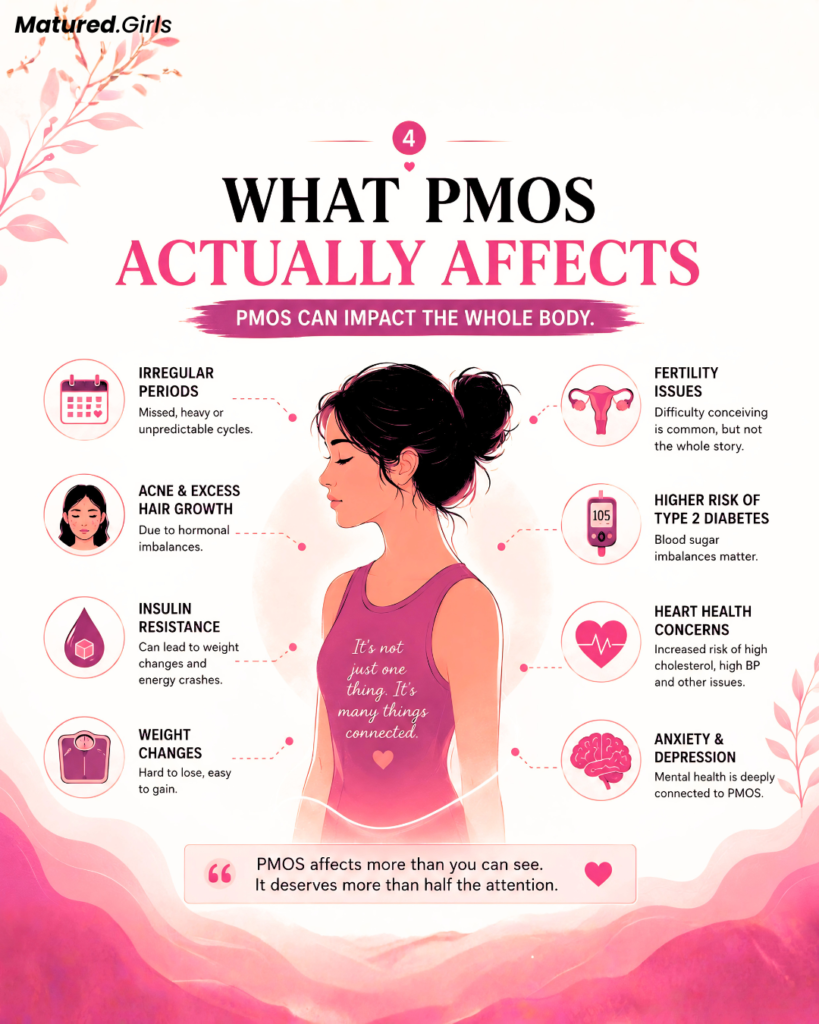
PMOS Symptoms: What Actually Happens in Your Body
The symptoms of PMOS are identical to PCOS. What changed is the understanding of why they happen.
Reproductive Symptoms
- Irregular or absent menstrual periods (most common symptom)
- Failure to ovulate despite having periods
- Difficulty conceiving (infertility)
- Recurrent miscarriage
Metabolic Symptoms (NOW EMPHASIZED)
- Insulin resistance (85% of PMOS patients have it)
- Weight gain, especially around the abdomen
- Difficulty losing weight despite dieting
- Type 2 diabetes risk (10-40x higher than average)
- Fatty liver disease
- High blood pressure
- High triglycerides and low HDL cholesterol
- Metabolic syndrome
Hormonal Symptoms
- High testosterone (elevated androgens)
- Imbalanced LH/FSH ratio
- Irregular cortisol patterns
Dermatological Symptoms
- Acne (severe, persistent, cystic)
- Hirsutism (excessive facial/body hair)
- Male-pattern baldness
- Darkening of skin patches (acanthosis nigricans)
Psychological Symptoms
- Depression (3-4x higher than general population)
- Anxiety disorders
- Mood disturbances
- Sleep disorders/sleep apnea
Cardiovascular Symptoms
- Increased heart disease risk
- Increased stroke risk
- Poor blood vessel function
The Key Insight: These aren’t separate problems needing separate treatments. They’re all manifestations of one underlying disorder: hormonal and metabolic dysfunction.
Under the old PCOS framework, a woman might receive:
- Birth control for irregular periods
- Spironolactone for acne
- Cosmetic solutions for hair growth
- Fertility drugs if trying to conceive
- Never addressing the metabolic foundation
Under the new PMOS framework, she gets:
- Metabolic assessment first (insulin, glucose, lipids)
- Insulin sensitization (metformin, inositol, lifestyle)
- Hormonal management as secondary intervention if needed
- Cardiovascular risk screening
- Mental health support
- Type 2 diabetes prevention
How PMOS Diagnosis Is Changing
The diagnostic criteria remain the same (Rotterdam criteria). What changed is the emphasis.
Old Diagnostic Approach (PCOS)
Doctors looked for:
- Irregular periods
- Elevated testosterone
- Polycystic ovaries on ultrasound
And often stopped there.
New Diagnostic Approach (PMOS)
Doctors now assess:
Hormonal Panel:
- Free and total testosterone
- LH (luteinizing hormone) and FSH (follicle-stimulating hormone)
- DHEA-S
- Androstenedione
Metabolic Panel (NOW STANDARD):
- Fasting insulin
- Fasting glucose
- 2-hour glucose tolerance test
- HbA1c (3-month average blood sugar)
- Lipid panel (cholesterol, triglycerides)
- Liver function tests
Imaging:
- Pelvic ultrasound
Additional Screening (NEW EMPHASIS):
- Mental health assessment (depression, anxiety screening)
- Cardiovascular risk evaluation
- Sleep apnea screening
- Type 2 diabetes risk assessment
The Game-Changer: Insulin resistance screening is now standard, not optional.
Why? Because 85% of PMOS patients have insulin resistance, and most don’t know it. Early identification of insulin resistance can prevent type 2 diabetes, cardiovascular disease, and metabolic complications.
[Source: Endocrine Society Guidelines, 2026]
PMOS Treatment: What’s Changing (And What Isn’t)
The medications remain largely the same. The philosophy has shifted.
First-Line Treatment: Metabolic Management
Insulin Sensitizers (Primary Focus Now):
- Metformin (1,500-2,000 mg daily) – reduces androgens, improves ovulation, prevents diabetes
- Inositol + D-chiro-inositol (40:1 ratio) – emerging evidence, particularly for insulin resistance
- Berberine – comparable to metformin in some studies, natural alternative
- GLP-1 agonists (semaglutide/Ozempic) – newer addition for significant metabolic improvement
Lifestyle (Non-Negotiable):
- Resistance training 3-4x/week (more effective than cardio for insulin sensitivity)
- Protein-rich nutrition
- Stress management
- Sleep optimization
Secondary Interventions (If Needed):
- Hormonal contraceptives (for period regulation, not first-line)
- Anti-androgens (spironolactone, for androgen symptoms)
- Mental health support
The Paradigm Shift
Before: “Manage the symptoms”
Now: “Treat the metabolic root cause, and symptoms often resolve”
This matters because when insulin resistance improves, many symptoms improve naturally:
- Periods often become regular
- Androgen levels often normalize
- Fertility often improves
- Weight becomes easier to manage
- Mental health often stabilizes
[CALLOUT BOX] The Single Most Important Change: Treatment now prioritizes metabolic health as the foundation, not hormonal symptom management. A woman on the metabolic-first PMOS protocol often sees complete symptom resolution in 12-24 months, compared to indefinite symptom management on the old PCOS approach. [/CALLOUT BOX]
The 3-Year Implementation Timeline: What Happens Now
The medical world isn’t switching overnight. Here’s the structured plan:
2026-2027: Education & Awareness
What’s happening now:
- Major international education campaign targeting healthcare professionals
- Patient resources translated into 20+ languages
- Medical schools incorporating PMOS into curricula
- Clinical guidelines updating to include PMOS terminology
- Healthcare systems beginning terminology transition
What you should do:
- Be aware both PCOS and PMOS are acceptable (they’re the same)
- Advocate for metabolic screening if not offered
- Ask your doctor about insulin resistance testing
2027-2028: Implementation
What’s happening:
- WHO updates the International Classification of Diseases (ICD) to officially include PMOS
- Medical societies globally adopt PMOS in clinical guidelines
- Electronic health records systems update terminology
- Insurance coding changes to reflect PMOS
- Research publications shift to the new name
What you should do:
- Ensure comprehensive metabolic screening is part of your care
- Request updated treatment plan emphasizing metabolic management
- Follow new diagnostic guidelines
2028+: Full Implementation
What’s happening:
- PMOS becomes the universal standard term
- PCOS terminology phased out (except in historical documents)
- New patients diagnosed with PMOS from the start
- Global research focuses on metabolic mechanisms
What to expect:
- Your medical records will eventually show PMOS
- All new research and publications use PMOS
- Younger patients will grow up understanding this is a metabolic disorder
Why This Matters for India (And All Women)
The name change has particular significance for India, where PMOS prevalence is among the highest globally.
The India-Specific Impact
Higher Prevalence:
- Global: 10% of women (170 million worldwide)
- India: 20-25% of women (estimated 50-60 million women affected)
Why higher in India?
- Genetic predisposition in South Asian populations
- Higher insulin resistance rates in Indian communities
- Greater metabolic syndrome prevalence
- Environmental and dietary factors
The Diagnostic Gap in India:
- 70% of cases go undiagnosed
- Limited specialist access outside metro areas
- PMOS traditionally missed in women not seeking fertility care
- Metabolic screening not routine in general practice
How the PMOS Name Helps India
- Early Diagnosis in Younger Women – Metabolic screening catches it before fertility is the concern
- Type 2 Diabetes Prevention – India already has a massive diabetes burden; early PMOS management prevents progression
- Cardiovascular Protection – South Asians have higher heart disease risk; metabolic management reduces this
- Affordable Interventions – Metformin and lifestyle changes are accessible and cost-effective
- Reframes Health Beyond Fertility – Women can seek care for weight, skin, and mood issues without fertility being the focus
Dr. Melanie Cree, pediatric endocrinologist at University of Colorado Anschutz, one of the few U.S. pediatric endocrinologists involved in the global naming process, emphasized:
“For too long, the narrow definition of PCOS has overlooked its metabolic and hormonal complexity, leaving many patients undiagnosed or misunderstood.”
For India, this narrow definition was particularly damaging.
[Source: CU Anschutz Medical Campus, May 2026]
FAQ: Questions Women Are Actually Asking
- Q: Is PCOS the same as PMOS?
- A: Yes, functionally identical. PMOS is the new official name reflecting current medical understanding. During the 3-year transition (2026-2028), both terms are acceptable. By 2028, PMOS becomes the standard.
- Q: Will my treatment change?
- A: Not immediately, but yes—eventually. Your doctor will now emphasize metabolic screening for insulin resistance and type 2 diabetes risk, not just fertility management. Treatment philosophy shifts from symptom management to metabolic root cause treatment.
- Q: Why 14 years to rename it?
- A: Global medical consensus required input from 50+ organizations, 22,000+ patient surveys, and careful consultation across 195 countries. Getting the name right was too important to rush.
- Q: When will my medical records update to PMOS?
- A: Gradually between now and 2028. Most healthcare systems will transition during the 3-year implementation window. You can request this update from your doctor.
- Q: Does PMOS mean I have multiple endocrine diseases?
- A: No. PMOS is one condition affecting multiple endocrine systems. The “polyendocrine” describes one syndrome’s complexity, not multiple separate diseases.
- Q: How does the new name improve diagnosis?
- A: By emphasizing metabolic components, doctors are now more likely to screen for insulin resistance, glucose intolerance, and metabolic syndrome—catching more cases earlier and preventing complications.
- Q: Is PMOS more common in India?
- A: Yes. Epidemiological data suggests 20-25% prevalence in India vs. 10% globally. The new name may help improve diagnosis rates in India where many cases are currently missed.
- Q: Can men have PMOS?
- A: No. The “Ovarian” component is specific to women. Men can have similar hormonal imbalances sometimes called “PCOS in men,” but the formal PMOS diagnosis applies to women.
- Q: What should I do right now?
- A: Ask your doctor to screen for insulin resistance, metabolic syndrome, and cardiovascular risk. Ensure you’re getting whole-body metabolic management, not just reproductive or fertility focus.
- Q: Does this mean my condition is curable?
- A: No, but it’s highly manageable. With proper metabolic management, many women see complete symptom resolution—regular periods return, androgen symptoms improve, weight normalizes. However, the underlying predisposition may persist if management stops.
The Bottom Line: Why This Moment Matters
A name might seem trivial. In medicine, it’s everything.
- The old name—PCOS—created a 90-year false narrative. It made the world think the problem was in the ovaries. It delayed diagnoses. It left 70% of women undiagnosed. It perpetuated stigma. It cost lives.
The new name—PMOS—corrects this historic error.
It says:
- This is a hormonal disorder
- This is a metabolic disorder
- This affects your whole body
- This requires whole-body medicine
- This deserves prevention, not just symptom management
For 170 million women globally—and 50-60 million in India alone—this name change is long overdue.
- For younger girls diagnosed in the future, they’ll know from the start: This isn’t just about your ovaries. This is about your metabolism. This is about your whole health. This is about prevention.
That’s the real power of accuracy.
Sources & Credits
[Source: Endocrine Society, May 2026] – Official announcement and clinical guidelines
[Source: The Lancet, May 2026] – “Polyendocrine Metabolic Ovarian Syndrome: Global Consensus Study” – Teede HJ et al. DOI: 10.1016/S0140-6736(26)00717-8
[Source: CU Anschutz Medical Campus, May 2026] – Pediatric endocrinology perspective
[Source: ScienceAlert, May 2026] – Historical and scientific context
[Source: EMJ Reviews, May 2026] – Global consensus overview
[Source: European Congress of Endocrinology, May 12, 2026, Prague] – Official announcement location

